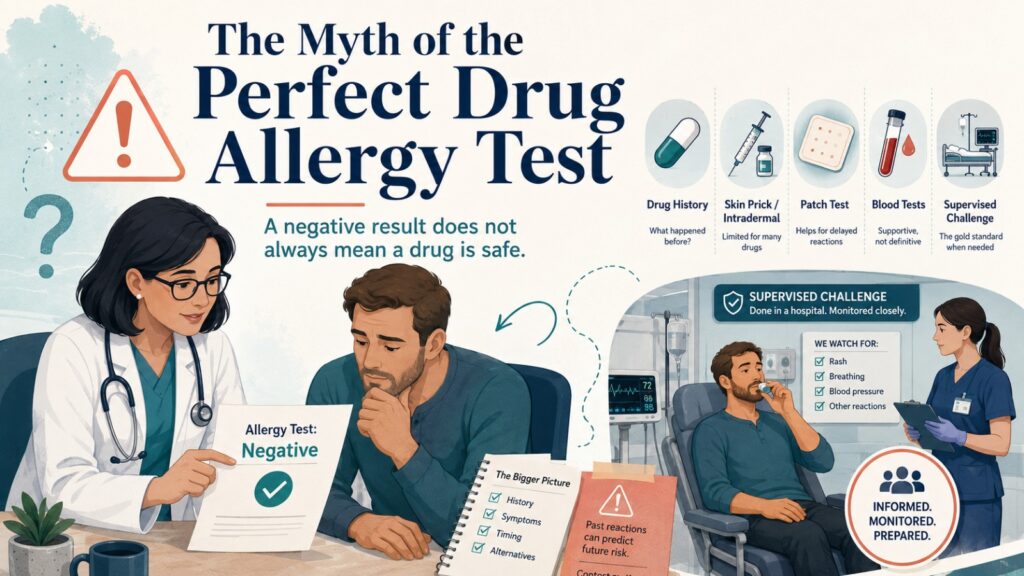
Drug allergy testing in Visakhapatnam should not be treated as a simple yes-or-no exercise. Many patients come to a clinic after being told they are allergic to an antibiotic, painkiller, anaesthesia medicine, or tablet taken years ago. Others have been reassured by a negative blood test or skin test, only to remain uncertain about whether the medicine is truly safe for them.
At Visakha Skin Clinic in Vizag, suspected drug allergy is approached by first understanding the reaction clearly. The timing, symptoms, severity, medicine involved, and previous drug tolerance often matter more than a single test result.
What Is Drug Allergy?
A drug allergy is an immune-mediated reaction to a medicine. This means the immune system is involved in producing symptoms such as hives, swelling, wheezing, rash, fever with rash, or more severe skin and internal organ reactions.
However, not every unpleasant symptom after taking a medicine is an allergy. Nausea after an antibiotic, acidity after a painkiller, loose motions after medication, or drowsiness after an antihistamine may be side effects rather than allergy.
Causes and Triggers
Drug reactions may occur with many types of medicines, including antibiotics, painkillers, anti-seizure medicines, anaesthesia-related drugs, injections, and over-the-counter tablets.
Antibiotics and painkillers are common reasons for suspected allergy labels. Some reactions happen within minutes to a few hours, while others appear after several days. This is why the timing of the reaction is very important when evaluating a possible drug allergy.
Some drug reactions are mild and limited to the skin. Others may involve fever, facial swelling, mouth ulcers, eye redness, skin peeling, liver involvement, kidney involvement, or blood abnormalities. These severe reactions need much more caution than a simple drug allergy test.
A detailed medical history helps identify the likely trigger and determine whether allergy testing, avoidance, or specialist evaluation is needed.
How It Is Diagnosed
Drug allergy evaluation begins with history. The consultation usually looks at the exact medicine taken, the dose, how soon symptoms appeared, what the symptoms were, how long they lasted, whether treatment or hospitalisation was needed, and whether the patient has taken the same or related medicines since then.
Photographs of the rash, previous prescriptions, discharge summaries, allergy reports, and laboratory results can be very useful. The pattern of the skin eruption also matters. A fixed drug eruption, urticaria, eczema-like rash, widespread drug rash, blistering reaction, or mucosal involvement may point toward different types of drug reaction.
Testing is chosen only after risk assessment. A skin prick test, intradermal test, patch test, blood test, or supervised drug challenge does not answer the same question. A negative result should always be interpreted in the context of the reaction history.
Treatment Options
The first step is not treatment, but classification. If the reaction was a predictable side effect, the patient may need counselling, dose adjustment, an alternative medicine, or gastroprotective measures rather than allergy labelling.
For suspected immediate allergy, symptoms such as hives, swelling of lips or eyelids, wheezing, throat tightness, dizziness, or collapse are important. In selected cases, skin prick testing or intradermal testing may help, especially for certain antibiotics.
For delayed drug allergy, such as rashes appearing after many hours or days, patch testing may sometimes be useful. It is more relevant for selected delayed skin reactions than for immediate allergy.
For low-risk histories, a supervised drug challenge may sometimes be the most useful way to assess current tolerance. This may involve giving a small dose first, observing the patient, then giving the remaining dose under medical supervision.
What to Expect
A consultation for drug allergy testing in Visakhapatnam may not always end with a test on the same day. Often, the first visit is used to reconstruct the reaction, identify risk level, review records, and decide whether testing is useful or unsafe.
If a test is appropriate, the doctor will explain what the test can and cannot detect. If a supervised challenge is appropriate, it must be planned with observation, emergency readiness, and clear documentation.
The goal is not to test all medicines. The goal is to answer a specific clinical question: what happened, how risky it was, which medicines should be avoided, and which alternatives may be considered.
Frequently Asked Questions
Does a negative drug allergy test mean the medicine is safe?
Not always. A negative result usually means that the specific test did not detect the specific type of reaction it was designed to look for. It may not rule out delayed reactions, side effects, intolerance, or severe non-IgE drug reactions.
Is a blood allergy test enough for drug allergy?
For most drug allergies, blood tests have limited value. Total IgE is not a drug allergy test, and a normal total IgE does not exclude drug allergy.
Can all antibiotics be tested at once?
No. Testing all antibiotics is usually not a useful or medically precise approach. The better method is to identify the suspected drug, understand the reaction, and decide whether evaluation is appropriate.
What is a drug challenge test?
A drug challenge involves giving the medicine under medical supervision, often in graded doses. It helps assess whether the patient currently tolerates that medicine.
Book an Appointment
If you are dealing with a suspected drug allergy, drug rash, antibiotic allergy label, or painkiller reaction and have not found clear answers, a structured consultation at Visakha Skin Clinic can help identify what is driving your reaction and what treatment or avoidance approach suits your skin.
Book an appointment today.