- Wrinkles & Lines Removal Treatment in Visakhapatnam
- Plastic Surgery Treatment in Visakhapatnam
- Eczema/ Dermatitis in Children Treatment in Visakhapatnam
- UVB and PUVA Phototherapy Treatment in Visakhapatnam
- Microdermabrasion Treatment in Visakhapatnam
- Dermaroller Treatment in Visakhapatnam
- Acne Scar removal Treatment in Visakhapatnam
- Pigmentation Treatment in Visakhapatnam
- Vitiligo Treatment in Visakhapatnam
- Psoriasis Treatment in Visakhapatnam
- Hair Loss Treatment in Visakhapatnam
- LASER Tattoo Removal, Tattoo Surgery and other methods: All you need to Know Treatment in Visakhapatnam
- Laser Hair Removal Treatment in Visakhapatnam
- Wart Treatment – The Things You Need to be Aware Of Treatment in Visakhapatnam
- How to Remove Dark Circles – What You Can Do Treatment in Visakhapatnam
- Black Spot Removal Treatment in Visakhapatnam
- Mole Removal – Things to Consider Treatment in Visakhapatnam
- Different Types of Birthmarks and Their Removal Methods Treatment in Visakhapatnam
- Acne, Scabies, Fungal Infections- Common Skin Problems Treatment in Visakhapatnam #VideoBlog
- Tele-Consultation on Whatsapp
- LASER TREATMENT FOR SKIN DISEASES
- Leg Ulcer Treatment in Visakhapatnam
- Skin Biopsy/ Histopathology Slide Reporting
- fraxel-co2-laser-therapy-the-ultimate-solution-for-skin-rejuvenation

LASER Tattoo Removal, Tattoo Surgery and other methods is a common skin disorder that may require medical evaluation for accurate diagnosis and long-term management. At Visakha Skin Clinic, patients with LASER Tattoo Removal, Tattoo Surgery and other methods are assessed by consultant dermatologists, and treatment is planned based on clinical findings, disease severity, and individual patient needs. Care focuses on evidence-based therapy and long-term disease control rather than short-term cosmetic measures.
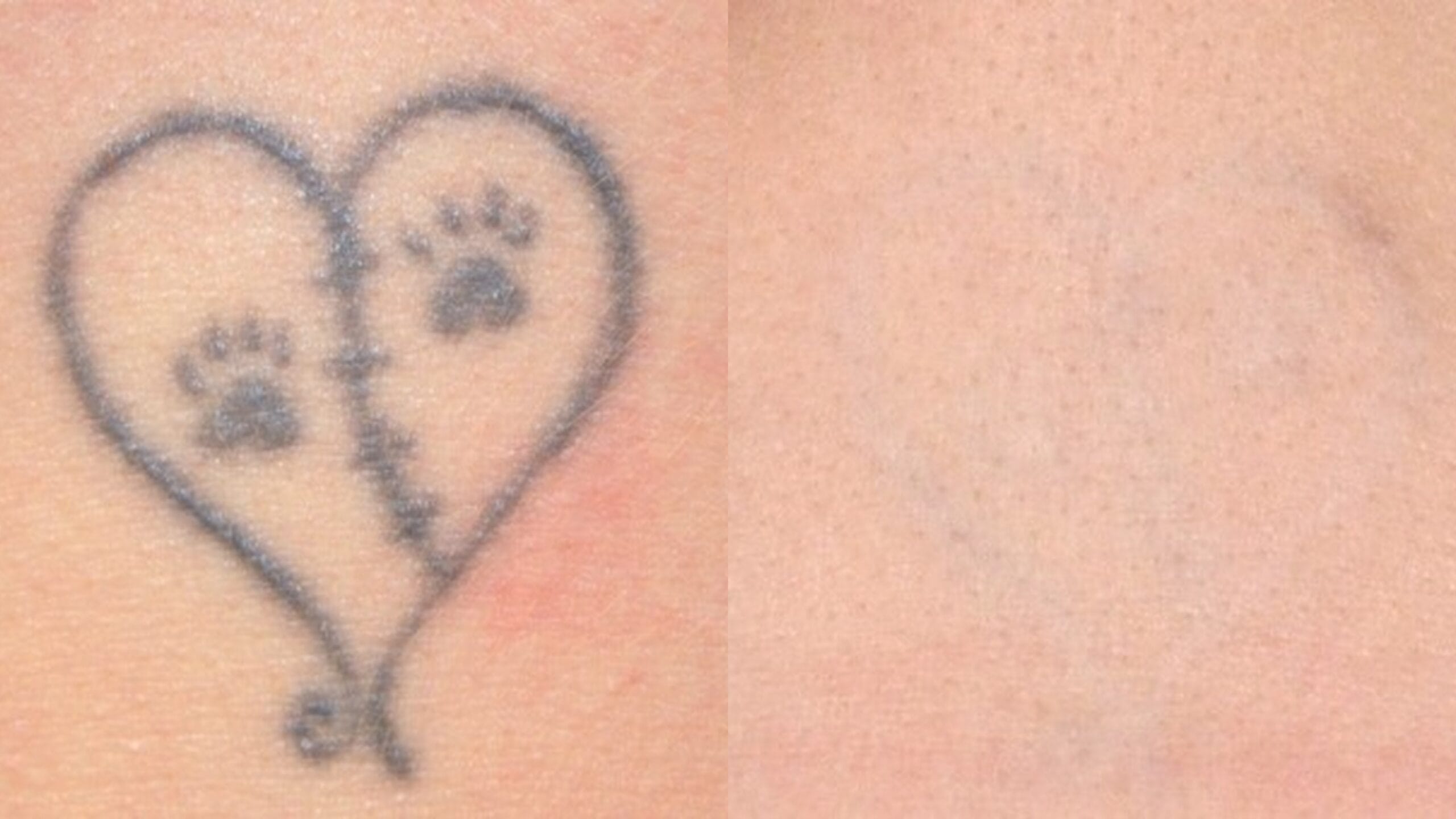
Tattoo’s can be aesthetically quite pleasing. However, there are a number of reasons why some folk may want to have their tattoo’s removed. These include- if applying for army/ navy jobs where some types of tattoo’s are not allowed, tattoo that relates to an ex- girlfriend or boy friend, fading tattoo, amateur/ incorrectly applied tattoo, etc.
There are essentially three methods by which Tattoo’s can be removed:
- Destruction:By using a chemical peel, radiofrequency/ Cautery device or Dermabrasion. All these procedures work by burning away the skin layers deep down to the tattoo pigments (underlocal anesthetic) and hence result in scarring. The resultant area often looks like a burn scar, after the area has healed (which may take 3-6 weeks). This method though not aesthetically that appealing is cheap and requires only a single sitting! Moreover removal of the tattoo is usually complete!
- Surgery:This involves cutting out the tattoo under local anesthetic and stitching the skin back together. The woundusually takes 1-2 weeks to heal completely. The resulting scar often looks like a line. However to allow adequate healing it is important to minimize any movement of the operated area for at least 2-3 weeks. Again this is an instant, single- sitting procedure that removes the tattoo completely.
- LASER: various lasers (Q-switched Nd: YAG, Alexandrite, Ruby, PDL) have come into the market in recent years. By far, the most popular is the Q-switched Nd: YAG Laser, mainly because it cantarget a wide range of colours. Laser light beams penetrate through the skin layers where the tattoo ink elements are located; strike the tattoo pigments and break them into minute pieces which are eliminated from the body through the immune system. This process is quite painless and fast in comparison to getting the actual tattoo. relate the experience to being hit by a rubber band. However, the pain can be minimized by taking pain relieving drugs such as Tylenol or Advil one hour before undergoing the process. You can also apply ice pack on the target area minutes before the procedure begins. Multiple sittings (between 6-10, with a 3-4 week gap between each sitting) are usually required to remove the tattoo. Often however, it is still possible to trace out the original tattoo if the skin is examined closely. Thus, the removal of the Tattoo is not 100%. Complete clearance depends on a number of factors- how old the tattoo is, the colors used, the tattoo location and how it was applied. Generally heavily colored tattoos or the ones applied skillfully and professionally are hard to remove. While yellow and green colors are tricky to remove they are easier to mask when doing cover-up tattoos. On the other hand, grey and black tattoos are easily removed. The advantage of Laser is that it is a non-invasive procedure which simply targets the tattoo pigments without usually affecting the surrounding area. However, laser removal may rarely cause scarring and pigmentary changes, especially if the tattoo needs multiple sittings.
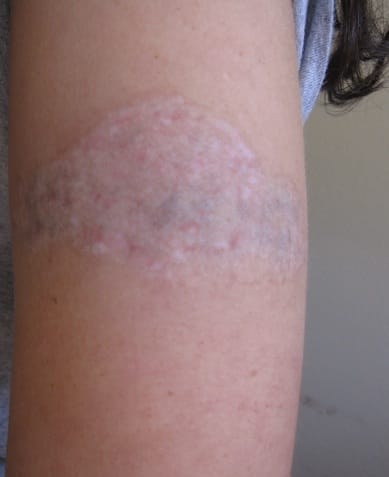
Scar caused by destructive tattoo treatment
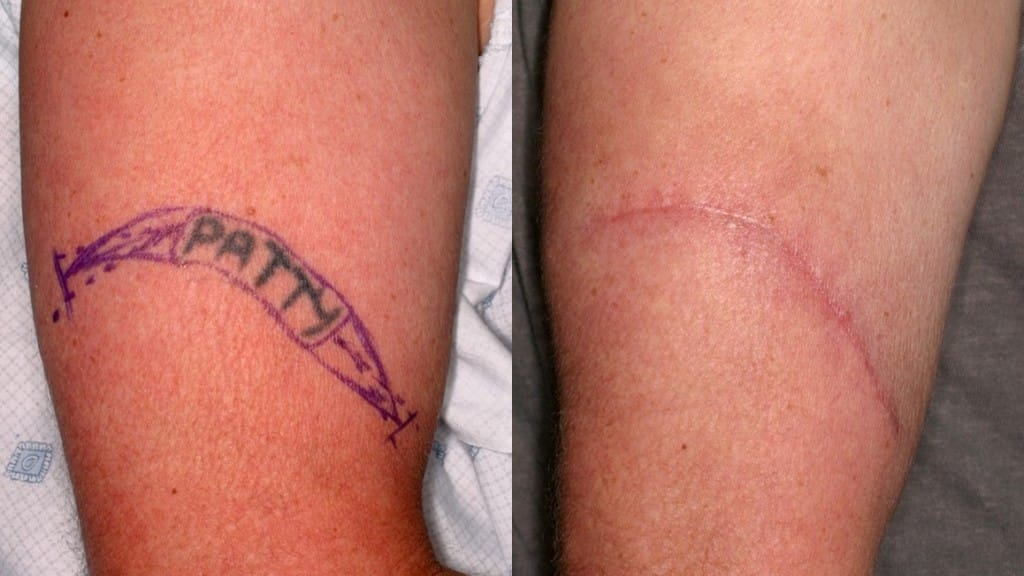
Surgical Excision of Tattoo
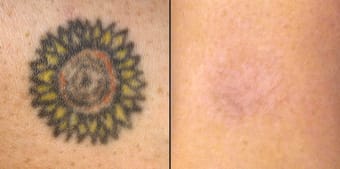
LASER Tattoo Removal
Here is a table illustrating the differences between these treatments:
| Procedure | Destructive Treatment | Surgery | LASER |
|---|---|---|---|
| Advantages | Single sitting Complete clearance (usually) | Single sitting Complete Clearance Neater scar | Minimal/ no scarring Non-invasive Minimal pain (no anesthesia required) |
| Disadvantages | Scar tissue- looks like a burn scar Recovery time 2-6 weeks Keloidal scarring possible | Recovery time 1-2 weeks Keloidal scarring possible | Multiple sittings required Takes 6-12 months for complete clearance Complete (100%) clearance not usually possible. Keloidal scarring very unlikely |
|---|
A note on the side-effects of Tattoo Removal: Almost all medical procedures have side effects. The end result (scarring) of destructive and surgical tattoo removal have already been discussed. In addition, any surgical or destructive procedure may sometimes lead secondary infection (which may need oral or i.v. antibiotics). Rarely an ugly expanding scar called a ‘Keloid’ Scar may develop. If this does happen, your doctor may need to treat this with intralesional steroid injections. If you have a tendency for keloidal scarring, Laser treatment would be a better option for you.
After undergoing laser removal procedure, you might experience blistering which is common. However, the blisters should be allowed to heal naturally to avoid scarring. Ensure you clean the area and apply antibiotic cream to avoid infection and heal faster. Prolonged negative effects are very rare. Though lasers do not usually damage your skin, in dark skinned people it can completely remove the natural skin color. Generally the skin color is restored after sometime when the skin fully recovers. However, darker skinned people who undergo several sessions might have skin areas that are more faded than others. Some colors might change to black when treated with Q-switched laser hence making it hard to remove the tattoo. This might happen with colors such as red, orange, brown, yellow and light colors that contain titanium dioxide or iron oxide compounds. These require additional therapies so as to remove the tattoo. Removing tattoos with red and yellow inks which contain mercuric or cadmium sulfides using laser techniques may cause extreme inflammation, infection or granulomas. This is rare but if you develop such a condition you should visit the doctor.