 Visakha Institute of Skin & Allergy
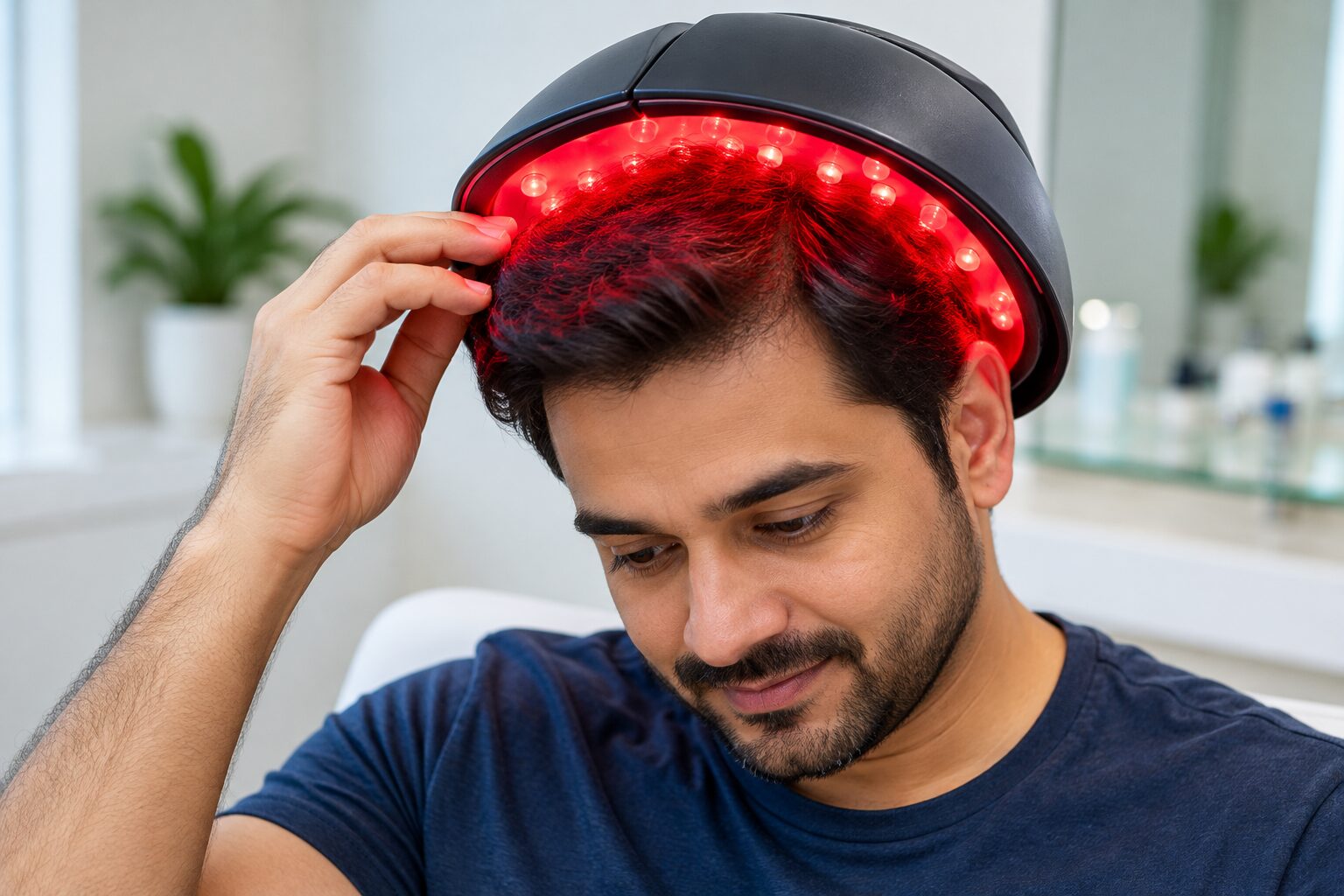
Are Laser Caps for Hair Loss Worth Buying in India?
Hair loss is common among men and women in India. For example, some people notice thinning hair or a receding hairline. As a result, hair loss may affect their confidence and quality of life.Several treatments are available. However, laser caps offer a convenient option for home use. Therefore, some people consider them as part of their hair-loss treatment plan.
But do laser caps really work? Are they worth the price in India? Also, should you choose one instead of established treatments such as minoxidil?
The best choice depends on the cause of hair loss. It also depends on the device and your expectations. Although laser therapy may help some people with pattern hair loss, the benefit is usually modest. Therefore, it is not a guaranteed solution.
If you are experiencing hair loss, learn more about our hair loss treatment options at our clinic.
What Are Laser Caps for Hair Loss?
Laser caps deliver low-level laser light to the scalp. They are also known as low-level laser therapy (LLLT) devices. In addition, some products are marketed as red-light hair growth devices.
These caps contain small light-emitting diodes or laser diodes. For example, some look like regular caps. Others resemble helmets or headbands. However, the design varies by model.
The treatment uses a process called photobiomodulation. In simple terms, light may affect activity within hair follicles. For example, it may influence cell signalling and hair growth. However, scientists have not fully established how these effects work.
In addition, laser cap therapy does not involve surgery, unlike hair transplantation. It also does not require applying medicine directly to the scalp, unlike topical treatments.
However, not all hair growth caps are the same. Devices can differ in design, quality and clinical evidence. Therefore, check the evidence for the exact product before buying it. General claims about red-light therapy do not prove that every device works.
How Does Laser Cap Therapy Work?
Laser cap therapy delivers low-level light to the scalp. The proposed mechanism involves the interaction of light with cellular components, potentially influencing energy production, cellular signalling, and the hair growth cycle.
Hair follicles normally move through three main phases:
- Anagen: the active growth phase.
- Catagen: the short transitional phase.
- Telogen: the resting phase, after which the hair may shed.
In people with androgenetic alopecia, commonly known as male-pattern or female-pattern hair loss, susceptible follicles gradually become smaller. This process is called follicular miniaturisation and can produce progressively thinner, shorter hairs.
Low-level laser therapy may help improve hair density in some people with pattern hair loss. However, the precise biological mechanisms and the degree of benefit are not fully established.
Laser caps cannot be expected to restore every lost hair or reverse all forms of baldness. Their potential usefulness depends on whether the affected follicles remain capable of producing hair.
Do Laser Caps Actually Regrow Hair?
Research suggests that low-level laser therapy can improve hair density in some people with pattern hair loss. However, the evidence does not mean that every laser cap available online will produce the same results.
A 2019 systematic review and meta-analysis examined eight studies involving 11 double-blind randomised controlled trials. It reported a statistically significant improvement in hair density among people treated with low-level laser therapy compared with those using sham devices.

PubMed https://pubmed.ncbi.nlm.nih.gov/30706177/
A separate 2021 systematic review and meta-analysis evaluated seven randomised controlled trials of home-use devices. It also found improved hair density compared with sham treatment. However, the authors noted that longer-term studies and further comparisons between devices were needed.
PubMed https://pubmed.ncbi.nlm.nih.gov/34980962/
These findings are encouraging, but there are important limitations:
- For example, many studies involved relatively small groups of participants.
- Also, treatment periods were generally measured in months, not years.
- Therefore, results from one device may not apply to every product on the market.
- In addition, increased hair density may not always lead to clearly visible hair regrowth.
- Finally, long-term effectiveness and the best treatment schedule remain uncertain.
Therefore, laser caps may help selected individuals. However, they should not be viewed as a guaranteed cure for baldness.
Are Laser Caps Better Than Minoxidil?
For most people with pattern hair loss, minoxidil is a more established treatment. In comparison, laser caps offer another option. However, research on individual laser devices is more limited. Therefore, people should compare the evidence before buying an expensive laser cap.
Minoxidil is a common treatment for pattern hair loss. Laser caps are another option. However, minoxidil has more established evidence. Research on laser caps is more limited. Therefore, compare both options before choosing a treatment.
Laser caps offer another way to treat hair loss. They do not require creams or liquid medicines. However, research on individual devices is limited. Therefore, results may vary between products.
The main differences are:
Minoxidil
- An established treatment for pattern hair loss.
- Available in topical formulations.
- Requires regular application.
- May cause scalp irritation or unwanted facial hair growth in some users.
- Benefits generally require continued treatment.
Laser caps
- Deliver low-level light to the scalp.
- Avoid the need for daily topical application, depending on the device’s schedule.
- Require consistent use over several months.
- Can involve a substantial upfront cost.
- Have evidence of potential benefit, but results vary by device and individual.
There is no reliable basis for claiming that laser caps are universally superior to minoxidil. If you are choosing only one treatment, discuss the most appropriate evidence-based option with a dermatologist before spending a large amount on a device.
Laser Caps: Cost, Value and Limitations in India
Laser caps can be expensive, particularly when imported into India. The final cost may depend on the manufacturer, device design, number of light sources, warranty, shipping charges, customs duties, and after-sales support.
Prices can vary considerably, so it is better to compare current quotations for specific models than rely on a single advertised price.
Before purchasing, consider the following factors.
1. Initial cost
Calculate the full cost of ownership, including shipping, taxes, accessories, warranty coverage, and possible replacement parts.
2. Evidence for the specific device
Look for published clinical studies evaluating the exact device or its underlying technology. General claims about laser therapy are not proof that a particular product works.
3. Treatment schedule
Check how often the manufacturer recommends using the cap and how long each session takes. A device that is inconvenient to use may not be a worthwhile investment.
4. Warranty and service in India
Confirm whether the company offers a valid warranty, accessible customer support, and a practical repair or replacement process for Indian customers.
5. Realistic expectations
A laser cap should not be purchased with the expectation of restoring a completely bald scalp or producing guaranteed results within a few weeks.
The key question is not simply whether a laser cap is expensive. It is whether the expected benefit justifies the cost for your particular type of hair loss.
Who Should Consider a Laser Cap?
Laser caps may be worth discussing with a dermatologist for people who have mild-to-moderate pattern hair loss and want to consider a non-invasive treatment option.
They may also be considered as an additional treatment for selected people who are already following an appropriate hair-loss treatment plan.
However, laser caps are not suitable as a substitute for investigating every form of hair loss.
A dermatologist’s assessment is particularly important if you have:
- Sudden or excessive hair shedding.
- Patchy areas of hair loss.
- Scalp redness, scaling, pain, or itching.
- Rapidly progressing hair loss.
- Hair loss associated with recent illness, major weight loss, nutritional problems, or medication changes.
- Signs of scarring or permanent damage to hair follicles.
Some causes of hair loss require treatment directed at the underlying condition. Using a laser cap without identifying the cause may delay appropriate care.
When to Seek a Dermatologist’s Advice
Hair loss can have many causes. Androgenetic alopecia is linked to genes and hormones. Other causes include alopecia areata, telogen effluvium, low nutrient levels, thyroid problems, scalp inflammation, and some medicines.
A dermatologist can examine the scalp, assess the pattern of hair loss, review your medical history, and recommend investigations when indicated.
Depending on the diagnosis, treatment may involve topical medication, prescription medication, correction of a confirmed deficiency, treatment of scalp disease, or other options.
Do not assume that a device advertised for hair growth will address the underlying cause of your hair loss.
How to Choose a Laser Cap in India
Understand the light source. Check if the product uses laser diodes, LEDs, or both. A higher diode count does not always mean better results.
First, check the device’s regulatory status. If the seller claims US FDA clearance, ask for proof. FDA clearance is not the same as FDA approval of a drug. It also does not guarantee hair growth.
Check the treatment protocol. Follow the manufacturer’s instructions and confirm that the proposed schedule is realistic for you.
Review safety instructions. Read the warnings, contraindications, and precautions, including any guidance regarding eye exposure and use with other treatments.
Verify the seller. Prefer an authorised seller who provides a clear invoice, warranty terms, return policy, and reliable support.
Avoid exaggerated claims. Be cautious of promises such as guaranteed regrowth, complete reversal of baldness, or dramatic results in a few days.
A careful purchase decision should be based on clinical evidence, device documentation, affordability, and realistic expectations rather than advertising alone.
Frequently Asked Questions
1. Do laser caps work for hair loss?
Some low-level laser therapy devices have demonstrated improvements in hair density in clinical studies involving pattern hair loss. However, results vary, and the evidence does not establish that every laser cap is effective.
2. How long does it take to see results?
Studies have commonly assessed outcomes over approximately 16–26 weeks. Any improvement may take several months, and not everyone responds. Follow the instructions for the specific device and discuss the expected timeline with your dermatologist.
3. Can a laser cap cure baldness?
No. Laser caps are not a proven cure for baldness. They may improve hair density in selected people with pattern hair loss, but they cannot be relied upon to restore hair where follicles have been permanently destroyed.
4. Can I use a laser cap with minoxidil?
Some people may use low-level laser therapy alongside other treatments, but the best combination depends on the diagnosis, the device, and individual circumstances. Discuss the plan with a dermatologist rather than changing prescribed treatment yourself.
5. Are laser caps safe?
Studies generally report a favourable safety profile for the devices investigated, with relatively few adverse effects. Nevertheless, safety depends on the particular device and how it is used. Follow the instructions and seek medical advice if irritation or other unexpected symptoms occur.
6. Are laser caps worth buying in India?
They may be worth considering for selected people who understand the limitations, can afford the device, and are prepared to use it consistently. For many people, identifying the cause of hair loss and prioritising established treatments may provide better value.
7. Should I buy a laser cap before consulting a dermatologist?
It is better to establish the cause of hair loss first. A correct diagnosis helps you avoid spending money on a treatment that may not address your problem.
Conclusion: Are Laser Caps for Hair Loss Worth Buying in India?
Laser caps are a promising but not definitive option for treating pattern hair loss. Clinical research suggests that some low-level laser therapy devices can improve hair density, but the magnitude of benefit, long-term results, and effectiveness of individual commercial products remain uncertain.
For most people, the sensible first step is to identify the cause of hair loss and discuss established treatment options with a qualified dermatologist.
If you are considering a laser cap, compare its price, clinical evidence, regulatory documentation, warranty, and treatment requirements before making a purchase. Treat it as a possible additional option rather than a guaranteed solution or a replacement for appropriate medical care.
The bottom line: Do not buy a laser cap simply because it promises hair regrowth. Make the decision based on your diagnosis, the evidence supporting the specific device, your budget, and realistic expectations.
This article is for educational purposes only and is not a substitute for individual medical advice.
References
1. Gupta AK, Carviel JL. Meta-analysis of photobiomodulation for the treatment of androgenetic alopecia. Journal of Dermatological Treatment. 2021;32(6):643–647. Published online in 2019. Available at: https://pubmed.ncbi.nlm.nih.gov/31746251/
2. Lueangarun S, Visutjindaporn P, Parcharoen Y, Jamparuang P, Tempark T. A Systematic Review and Meta-analysis of Randomized Controlled Trials of United States Food and Drug Administration-Approved, Home-use, Low-Level Light/Laser Therapy Devices for Pattern Hair Loss: Device Design and Technology. Journal of Clinical and Aesthetic Dermatology. 2021;14(11):E64–E75. Available at: https://pubmed.ncbi.nlm.nih.gov/34980962/
3. Pillai JK, Mysore V. Role of Low-Level Light Therapy (LLLT) in Androgenetic Alopecia. Journal of Cutaneous and Aesthetic Surgery. 2021;14(4):385–391. doi:10.4103/JCAS.JCAS_218_20. Available at: https://pubmed.ncbi.nlm.nih.gov/35283601/
4. Adil A, Godwin M. The effectiveness of treatments for androgenetic alopecia: A systematic review and meta-analysis. Journal of the American Academy of Dermatology. 2017;77(1):136–141.e5. Available at: https://pubmed.ncbi.nlm.nih.gov/28396101/
5. American Academy of Dermatology. Hair loss: Diagnosis and treatment. Available at: https://www.aad.org/public/diseases/hair-loss/treatment
Reference note: Please verify bibliographic details and the current accessibility of each source before publication.