
Patients with eczema, recurrent hives or suspected food allergy are often advised to undergo an IgE test, an allergy blood panel or skin-prick testing. But an abnormal allergy test does not always mean that the substance identified is actually causing the skin problem. If you are considering allergy testing in Visakhapatnam, the most useful starting point is usually a careful assessment of what happens after a suspected exposure, rather than testing against as many allergens as possible. At Visakha Skin Clinic in Vizag, the aim is to interpret allergy symptoms and previous test results in the context of the patient’s actual skin disease.
What Is Allergy Testing?
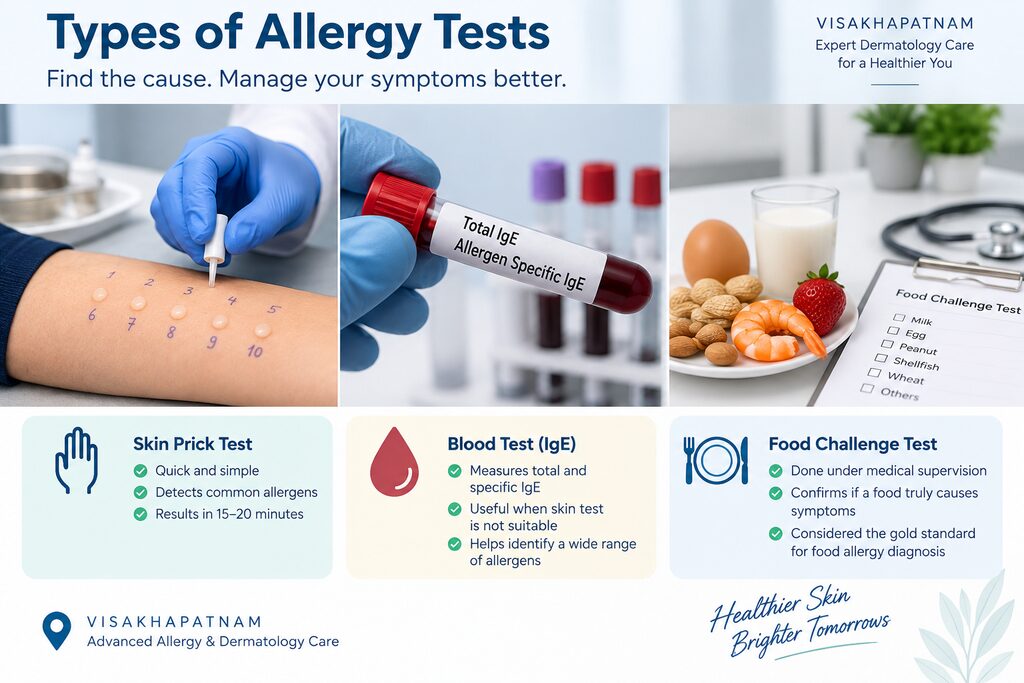
Allergy testing can include total serum IgE, allergen-specific IgE blood tests—sometimes still called RAST tests—and skin-prick testing.
Total IgE measures the overall amount of IgE antibody in the blood. Specific-IgE testing checks for IgE antibodies against particular allergens such as foods, pollens or house-dust mites, while a skin-prick test assesses whether the skin reacts to a small amount of an allergen extract.
These tests can be useful, but they do not all answer the same question. Most importantly, a positive specific-IgE or skin-prick result can indicate sensitisation without proving clinical allergy.
For reliable information about allergy testing, see the American Academy of Allergy, Asthma & Immunology (AAAAI)
Someone may therefore test positive to a food or pollen but experience no symptoms when exposed to it. This distinction is central to interpreting allergy tests correctly.
Causes and Triggers of Suspected Allergy
Different skin conditions can produce symptoms that patients understandably interpret as “allergy”.
Atopic dermatitis, or eczema, naturally fluctuates. Heat, sweating, dry skin, irritants, infections and environmental changes can all contribute to flares. In a warm and humid coastal city such as Visakhapatnam, sweating and irritation may also aggravate eczema in some patients without an underlying food allergy being responsible.
Urticaria, or hives, can also occur for reasons other than an external allergen. In chronic spontaneous urticaria, recurrent wheals are usually not explained by repeatedly eating one unidentified food or by exposure to pollen or dust mites.
True immediate IgE-mediated food allergy usually produces a recognisable pattern. Symptoms typically develop within minutes to around one or two hours after eating the responsible food and may include hives, swelling, itching, vomiting, abdominal symptoms, wheezing, breathlessness or, occasionally, a severe systemic reaction.
The pattern and timing of symptoms therefore matter as much as the test result.
How Allergy Testing in Visakhapatnam Is Interpreted
The first step is usually not another laboratory panel. It is establishing exactly what problem needs to be explained.
A dermatology assessment may include:
- The type of rash or skin condition present
- How long symptoms have been occurring
- Whether symptoms are continuous or intermittent
- Foods, medicines or environmental exposures suspected by the patient
- How quickly symptoms occur after exposure
- Whether the same reaction happens repeatedly
- Foods that the patient continues to eat without problems
- Previous IgE, RAST or skin-prick test results
- Treatments already tried
For example, someone who repeatedly develops hives and swelling shortly after eating the same food presents a very different diagnostic problem from someone with chronic eczema who has several positive results on a broad allergy panel but eats those foods without an immediate reaction.
Tests are most useful when they help resolve that kind of specific uncertainty.
Treatment Options
Treatment depends on the condition causing the symptoms, not simply on whether an IgE result is above the laboratory reference range.
First-line management begins with establishing the correct skin diagnosis. A patient with eczema requires appropriate eczema treatment and skin-barrier care. A patient with chronic spontaneous urticaria requires management directed at the urticaria itself. A laboratory result should not replace treatment of the underlying clinical condition.
When you strongly suspect a food or allergen, the doctor reviews your history carefully. This helps determine whether further testing could change your treatment. A food-and-symptom diary can sometimes help when the relationship is unclear, particularly when patients believe that a particular exposure repeatedly triggers hives, swelling or another immediate symptom.
A specialist may recommend specific-IgE or skin-prick testing when only a few allergens remain uncertain. If doctors need to confirm whether a food causes IgE-mediated allergy, they may recommend a medically supervised oral food challenge.
What should generally be avoided is making major dietary or lifestyle restrictions solely because a broad panel contains several positive results. People with atopic conditions can show sensitisation to several allergens without having clinical allergies to all of them.Avoiding foods you regularly eat without symptoms can cause unnecessary dietary restrictions and anxiety. It may not improve the skin disease.
Similarly, a very high total IgE level should not automatically become a treatment target. In atopic dermatitis, the patient’s skin, symptoms and disease control matter more than trying to make the IgE number return to the laboratory reference range.
[LINK: Atopic dermatitis treatment page]
[LINK: Chronic urticaria treatment page]
What to Expect
The aim of an allergy-focused dermatology consultation is not necessarily to identify something new to avoid. It is to determine whether allergy is actually relevant to the patient’s symptoms.
Patients who already have IgE, RAST or skin-prick reports can bring those results to the consultation.Doctors can then interpret the results alongside symptom timing, clinical examination and previous treatment response.
In some patients, a targeted allergy investigation may be appropriate. In others, the more useful outcome may be reassurance that multiple positive results do not explain the skin problem and that treatment should instead focus on eczema, urticaria or another dermatological diagnosis.
Doctors mainly assess improvement by looking at the patient’s symptoms and skin disease. They do not rely on a falling total IgE value.
Frequently Asked Questions
Does a high IgE mean I have an allergy?
Not necessarily.Total IgE is often high in people with eczema. However, it does not identify the allergen causing symptoms.
A high IgE also does not reliably indicate how severe an individual’s eczema is. It should therefore be interpreted alongside the clinical diagnosis rather than treated as a disease by itself.
If my food allergy blood test is positive, should I stop eating that food?
Not automatically. A positive specific-IgE result can indicate sensitisation without proving that eating the food causes clinical allergy.
If you regularly eat the food without symptoms, the result needs careful interpretation. Avoid unnecessary dietary restrictions based only on a positive blood test.
Is skin-prick testing accurate for food allergy?
Doctors use skin-prick testing when they need to investigate a specific allergy. The result needs to match the patient’s actual reaction when the food is eaten.
Where significant uncertainty remains, further specialist assessment—and in selected cases a medically supervised oral food challenge—may be more informative.
Should patients with eczema have allergy testing?
Not routinely in every case. People with eczema may have high IgE and several positive sensitisation tests. These allergens may not be causing the eczema.
Testing becomes more useful when the clinical history suggests a specific, reproducible immediate reaction that requires investigation.
Do people with chronic urticaria need food allergy panels?
Usually not as a routine investigation. Chronic spontaneous urticaria is usually not caused by an unidentified food allergy. Broad testing may find sensitisation that does not explain the wheals.
The priority is to diagnose and treat the urticaria appropriately while investigating specific triggers only when the history genuinely supports them.
I already have a long allergy report. Can it be reviewed without repeating all the tests?
Yes. Previous IgE, RAST or skin-prick reports can often be interpreted in the context of the patient’s symptoms before deciding whether any further testing is necessary.
The key question is whether each positive result has a believable relationship with what happens when the patient is actually exposed to that allergen.
If you are dealing with eczema, recurrent urticaria or suspected allergy and have not found lasting relief, a structured consultation at Visakha Skin Clinic can help identify what is driving your symptoms, whether your allergy-test results are clinically relevant, and what treatment approach suits your skin. [Book an appointment / Contact us]