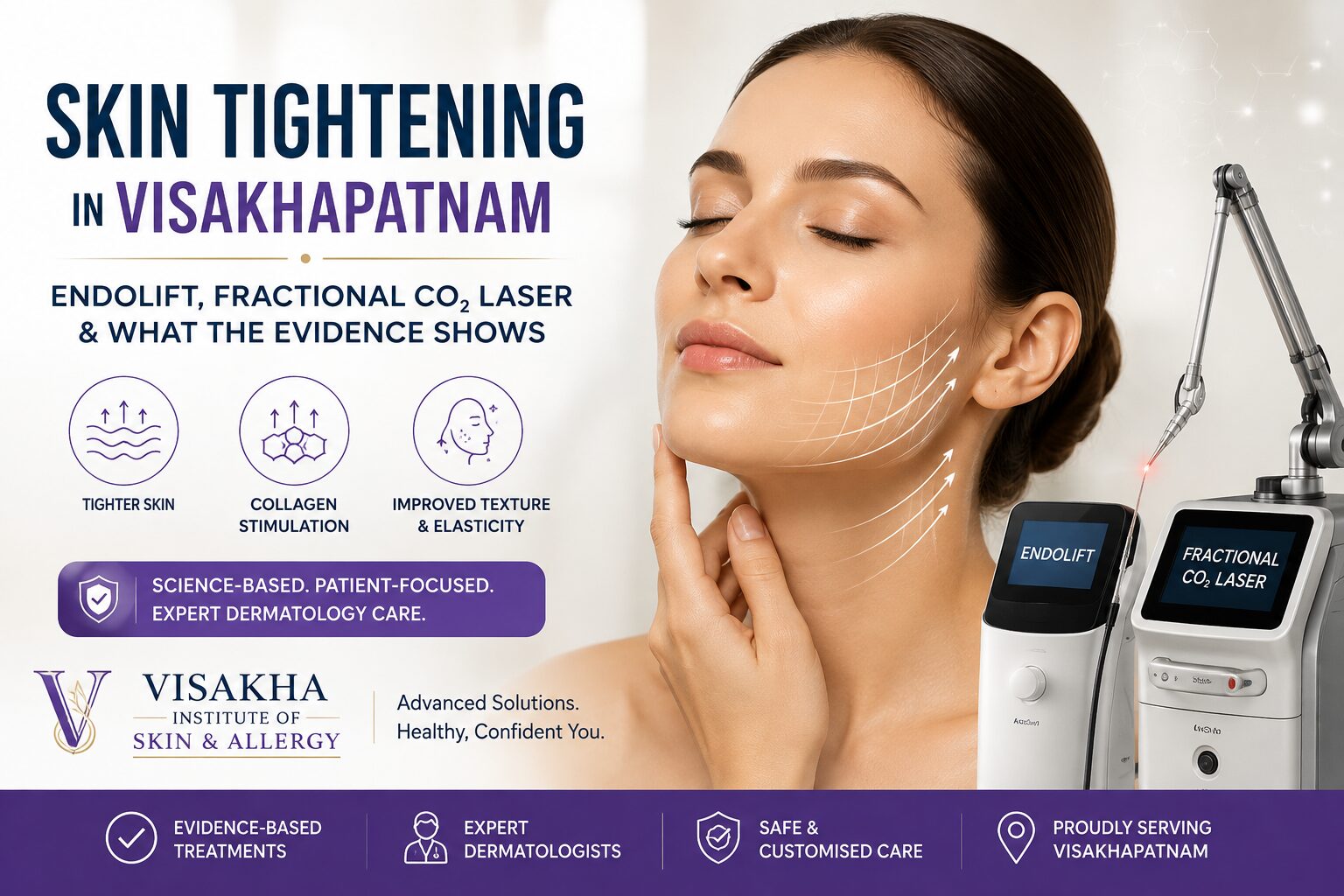
Patients in Visakhapatnam are increasingly considering skin tightening treatments as alternatives to surgery. These include Endolift and fractional laser procedures. The treatment names may sound similar, but they work at different depths and have different levels of supporting evidence. At Visakha Skin Clinic, clinicians choose treatment based on the cause of the visible concern rather than device popularity. For patients in Vizag, this distinction helps identify whether the main concern is wrinkles and skin quality, deeper lower-face heaviness, or a complication from a previous aesthetic procedure.
What Is Skin Tightening?
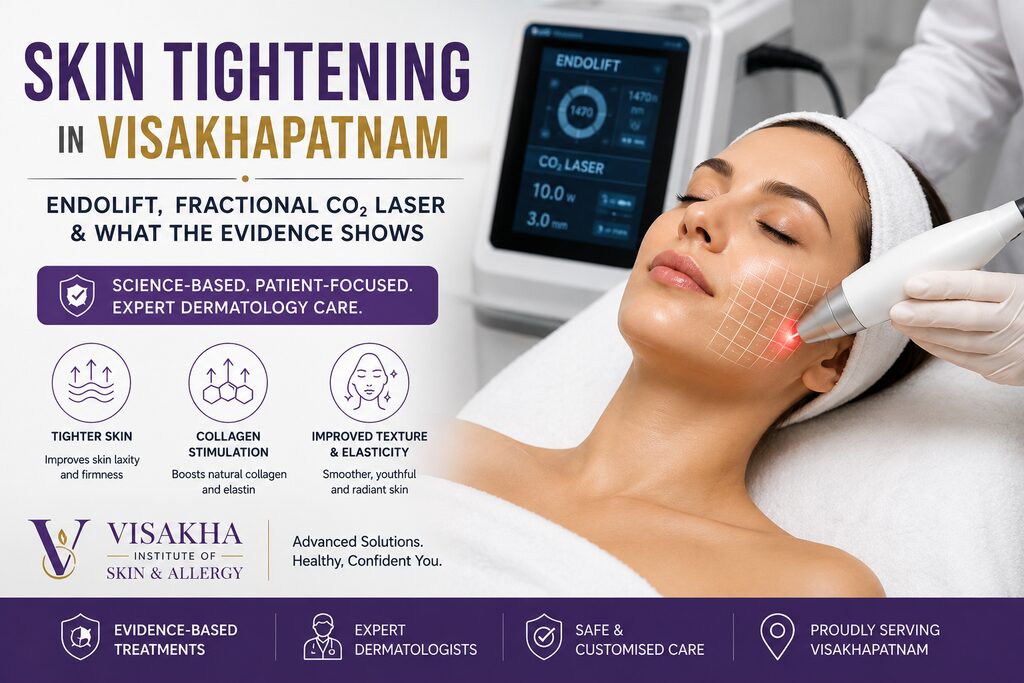
“Skin tightening” is a broad term rather than a single treatment. Different devices deliver energy into different anatomical layers. Therefore, they may produce different results.
Endolift uses a 1470-nm diode laser delivered through a fine optical fibre inserted beneath the skin. The fibre delivers thermal energy to deeper dermal and superficial subcutaneous tissues. It may also affect superficial fat, depending on the treatment plane and energy used.
Fractional CO₂ laser works differently. It treats the skin from the surface in a fractional pattern and has an established role in dermal remodelling, including improvement of wrinkles, photodamage, texture and collagen organisation.
Causes and Triggers
Patients seeking skin tightening may have different problems. Fine wrinkles, poor texture and photodamage are different from lower-face heaviness or jowling. Deeper tissues may contribute to jowling.
Previous cosmetic treatment also matters. Thermal procedures may affect hyaluronic-acid filler..
Delayed inflammatory reactions to HA filler can cause swelling, tenderness or nodules long after the original injection.
Dermal Filler Treatment and Complications
How It Is Diagnosed
Start by defining what the patient wants to improve. Wrinkles, skin texture and skin laxity are different concerns. Lower-face heaviness can also have a deeper cause.
The clinician should also review previous procedures, including filler injections and energy-based treatments.
When symptoms develop after Endolift near previous filler, the clinician should consider several possible causes instead of assuming one diagnosis.These include a filler-related inflammatory reaction, an effect of thermal energy on previously injected material, infection or a direct procedural complication.
Treatment Options for Skin Tightening in Visakhapatnam
Fractional CO₂ laser
For patients whose principal concerns are wrinkles, photodamage, texture and dermal remodelling, fractional CO₂ laser has a comparatively mature evidence base.
One prospective study objectively assessed skin mechanical properties using a Cutometer before and after fractional CO₂ resurfacing and reported a 5.9% improvement in elasticity together with significant changes in other biomechanical measurements. A separate split-face human study examined tissue after fractional CO₂ treatment and found significantly greater type I and type III collagen on the treated side compared with an untreated control side.
These studies do not mean fractional CO₂ is the correct procedure for every patient. They do, however, provide objective evidence that the treatment produces measurable dermal remodelling rather than relying only on photographs or subjective assessment.
Fractional CO₂ laser treatment
Endolift
Endolift delivers energy beneath the skin and therefore reaches structures that fractional CO₂ does not directly treat.
Studies have reported improvements following treatment, and human histology has demonstrated increased dermal thickness and collagen deposition after subdermal 1470-nm laser exposure at moderate energy settings. However, the overall evidence base remains less mature. Reviews have identified limitations including observational study designs, inconsistent treatment parameters and incomplete safety data.
Its deeper treatment plane may eventually prove particularly useful where superficial fat or fibrous septa contribute to lower-face heaviness or jowling. At present, however, the supplied evidence does not demonstrate that Endolift produces greater overall skin tightening than fractional CO₂.
When previous filler is present
Include any previous filler history in treatment planning, even when patients received filler months or years earlier.
Evidence suggests that heat may affect HA filler. Delayed inflammatory reactions can also occur after filler treatment.
The appropriate conclusion is therefore not that such treatment is proven unsafe, but that the interaction is insufficiently studied.
What to avoid
Treatment should not be selected simply because a device is described as stimulating collagen. Multiple established technologies can stimulate collagen through different mechanisms.
It is also inappropriate to treat regulatory clearance of a laser platform as proof that one aesthetic procedure is clinically superior to another. Patients should ask what outcome is being targeted, what evidence supports that outcome, and whether the treatment plane makes sense for their particular anatomy.
What to Expect
Neither Endolift nor fractional CO₂ should be presented as producing a guaranteed degree of tightening.
Fractional CO₂ has objective evidence for collagen remodelling. It can also change skin mechanical properties. Endolift has early clinical and tissue evidence. However, treatment settings vary between studies. Current evidence does not show that Endolift is superior.
Results should therefore be assessed over time rather than judged solely from immediate post-treatment appearance. Follow-up should also take into account the original treatment goal, previous filler history and any persistent symptoms such as swelling, tenderness or pain.
For patients in Vizag considering laser skin tightening, the most useful consultation is one that first determines which anatomical layer actually needs treatment.
Frequently Asked Questions
Is Endolift better than fractional CO₂ laser?
Studies have reported improvement after Endolift. Human tissue studies also found increased dermal thickness and collagen after subdermal 1470-nm laser treatment.
Does Endolift stimulate collagen?
Yes, biological evidence supports a collagen response after subdermal 1470-nm laser treatment. A human histological study reported increased dermal thickness and collagen deposition at moderate energy levels, although less favourable collagen and elastin changes appeared at the highest energy tested.
Can fractional CO₂ tighten skin?
Fractional CO₂ can produce measurable dermal remodelling. Published studies cited in the source include objective biomechanical measurements and controlled human histology demonstrating changes in elasticity and collagen.
Can Endolift be performed over old filler?
There is insufficient published evidence in the supplied literature to give a simple yes-or-no answer. Thermal energy can interact with HA filler, and no study cited in the source specifically evaluates Endolift performed through or adjacent to pre-existing HA filler.
What should I do if I have persistent swelling or pain after Endolift?
Persistent pain, tenderness or swelling after an aesthetic procedure deserves clinical assessment rather than assumption about the cause. When previous filler is present in the same area, filler-related inflammation, thermal effects, infection and direct procedural complications may all need consideration.
If you are dealing with facial skin laxity and have not found lasting relief, a structured consultation at Visakha Skin Clinic can help identify what is driving your skin laxity and what treatment approach suits your skin. Book an appointment / Contact us
Selected References
- Longo L, Dell’Avanzato R, Longo D. Laser Therapy. 2022;29:115–120. doi:10.4081/ltj.2022.298.
- Nilforoushzadeh MA, Heidari A, Ghane Y, et al. Aesthetic Plastic Surgery. 2024;48:5097–5114. doi:10.1007/s00266-024-04082-2.
- Modena DAO, Yamamoto APM, da Silva TBF. Lasers in Medical Science. 2025;40:22. doi:10.1007/s10103-025-04288-z.
- Bollero D, Orlando G, Dell’Avanzato R, et al. Laser Therapy. 2025;32(1). doi:10.4081/ltj.2025.422.
- Naouri M, Atlan M, Perrodeau E, et al. Journal of Cosmetic Dermatology. 2012;11:201–206. doi:10.1111/j.1473-2165.2012.00627.x.
- Sartori JF, Osaki TH, Osaki MH, et al. Aesthetic Surgery Journal. 2022;42:239–248. doi:10.1093/asj/sjab357.
- Yi KH. Plastic and Aesthetic Research. 2024;11:56. doi:10.20517/2347-9264.2024.119.